Summary: in this tutorial, you’ll learn how to use Django in to check if a value is in a set of values.
Introduction to the Django In #
We’ll use the Employee model in the HR application for the demonstration. The Employee model maps to the hr_employee table in the database:
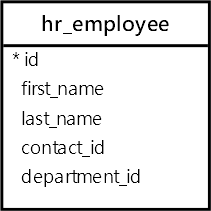
The SQL IN operator returns true if a value is in a set of values:
field_name IN (v1, v2, ...)Code language: Python (python)For example, you can use the IN operator to query the rows from the hr_employee table whose department_id is in a list like this:
SELECT *
FROM hr_employee
WHERE department_id IN (1,2,3)Code language: SQL (Structured Query Language) (sql)
In Django, you use the in operator:
>>> Employee.objects.filter(department_id__in=(1,2,3))
SELECT "hr_employee"."id",
       "hr_employee"."first_name",
       "hr_employee"."last_name",
       "hr_employee"."contact_id",
       "hr_employee"."department_id"
  FROM "hr_employee"
 WHERE "hr_employee"."department_id" IN (1, 2, 3)Code language: SQL (Structured Query Language) (sql)
Typically, you use a subquery with the in operator rather than a list of literal values. For example, you find all employees in the Sales and Marketing departments as follows:
>>> departments = Department.objects.filter(Q(name='Sales') | Q(name='Marketing'))
>>> Employee.objects.filter(department__in=departments)
SELECT "hr_employee"."id",
       "hr_employee"."first_name",
       "hr_employee"."last_name",
       "hr_employee"."contact_id",
       "hr_employee"."department_id"
  FROM "hr_employee"
 WHERE "hr_employee"."department_id" IN (
        SELECT U0."id"
          FROM "hr_department" U0
         WHERE (U0."name" = 'Sales' OR U0."name" = 'Marketing')
       )Code language: SQL (Structured Query Language) (sql)
How it works.
First, get the departments with the names Sales or Marketing:
departments = Department.objects.filter(Q(name='Sales') | Q(name='Marketing'))Code language: Python (python)Second, pass the department QuerySet to the in operator:
Employee.objects.filter(department__in=departments)Code language: Python (python)Behind the scenes, Django executes a query with the IN operator that matches the department id with a list of department id from a list:
SELECT "hr_employee"."id",
       "hr_employee"."first_name",
       "hr_employee"."last_name",
       "hr_employee"."contact_id",
       "hr_employee"."department_id"
  FROM "hr_employee"
 WHERE "hr_employee"."department_id" IN (
        SELECT U0."id"
          FROM "hr_department" U0
         WHERE (U0."name" = 'Sales' OR U0."name" = 'Marketing')
       )Code language: SQL (Structured Query Language) (sql)
NOT IN #
The NOT operator negates the IN operator. The NOT IN operator returns true if a value is not in a list of values:
field_name NOT IN (v1, v2, ...)To perform NOT IN in Django, you can use the Q object and ~ operator:
~Q(field_name__in=(v1,v2,..))Code language: Protocol Buffers (protobuf)For example, the following finds employees whose department id is not 1, 2, or 3:
>>> Employee.objects.filter(~Q(department_id__in=(1,2,3)))
SELECT "hr_employee"."id",
       "hr_employee"."first_name",
       "hr_employee"."last_name",
       "hr_employee"."contact_id",
       "hr_employee"."department_id"
  FROM "hr_employee"
 WHERE NOT ("hr_employee"."department_id" IN (1, 2, 3))Code language: SQL (Structured Query Language) (sql)
Alternatively, you can use the exclude() method instead of the filter() method:
>>> Employee.objects.exclude(department_id__in=(1,2,3))
SELECT "hr_employee"."id",
       "hr_employee"."first_name",
       "hr_employee"."last_name",
       "hr_employee"."contact_id",
       "hr_employee"."department_id"
  FROM "hr_employee"
 WHERE NOT ("hr_employee"."department_id" IN (1, 2, 3))Code language: JavaScript (javascript)
Summary #
- Use the Django
into check if a value is in a list of values.
| Django ORM | SQL |
|---|---|
Entity.objects.filter(id__in=(v1,v2,v3) | id IN (v1,v2,v3) |
Entity.objects.filter(~Q(id__in=(v1,v2,v3)) | NOT (id IN (v1,v2,v3)) |
Entity.objects.exclude(id__in=(v1,v2,v3) | NOT (id IN (v1,v2,v3)) |

