What is MobileComputing? Definition and Key Concepts
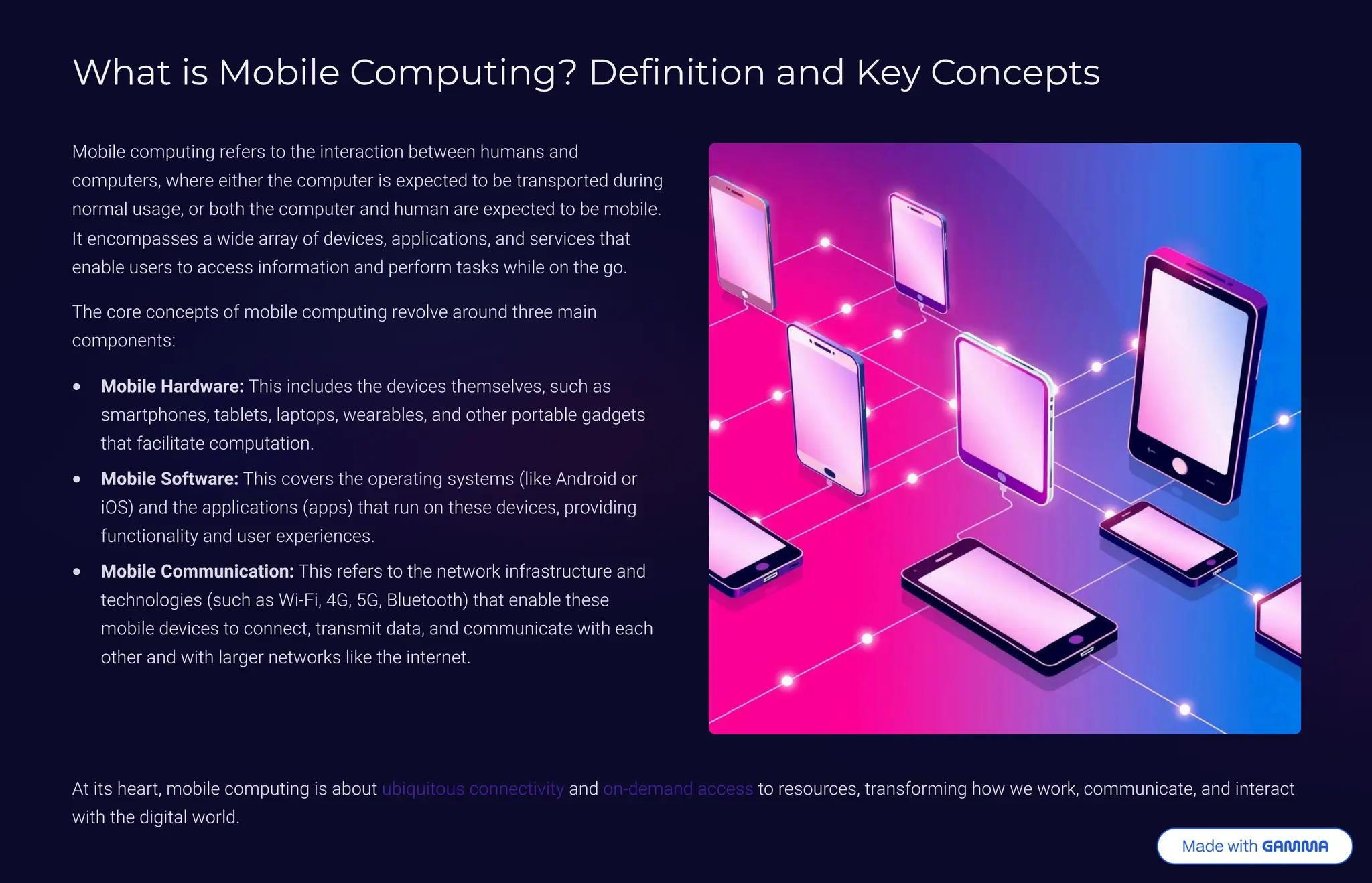
Mobile computing refers to the interaction between humans and
computers, where either the computer is expected to be transported during
normal usage, or both the computer and human are expected to be mobile.
It encompasses a wide array of devices, applications, and services that
enable users to access information and perform tasks while on the go.
The core concepts of mobile computing revolve around three main
components:
Mobile Hardware: This includes the devices themselves, such as
smartphones, tablets, laptops, wearables, and other portable gadgets
that facilitate computation.
Mobile Software: This covers the operating systems (like Android or
iOS) and the applications (apps) that run on these devices, providing
functionality and user experiences.
Mobile Communication: This refers to the network infrastructure and
technologies (such as Wi-Fi, 4G, 5G, Bluetooth) that enable these
mobile devices to connect, transmit data, and communicate with each
other and with larger networks like the internet.
At its heart, mobile computing is about ubiquitous connectivity and on-demand access to resources, transforming how we work, communicate, and interact
with the digital world.
3.
History and Evolution:From Pagers to Smartphones
1
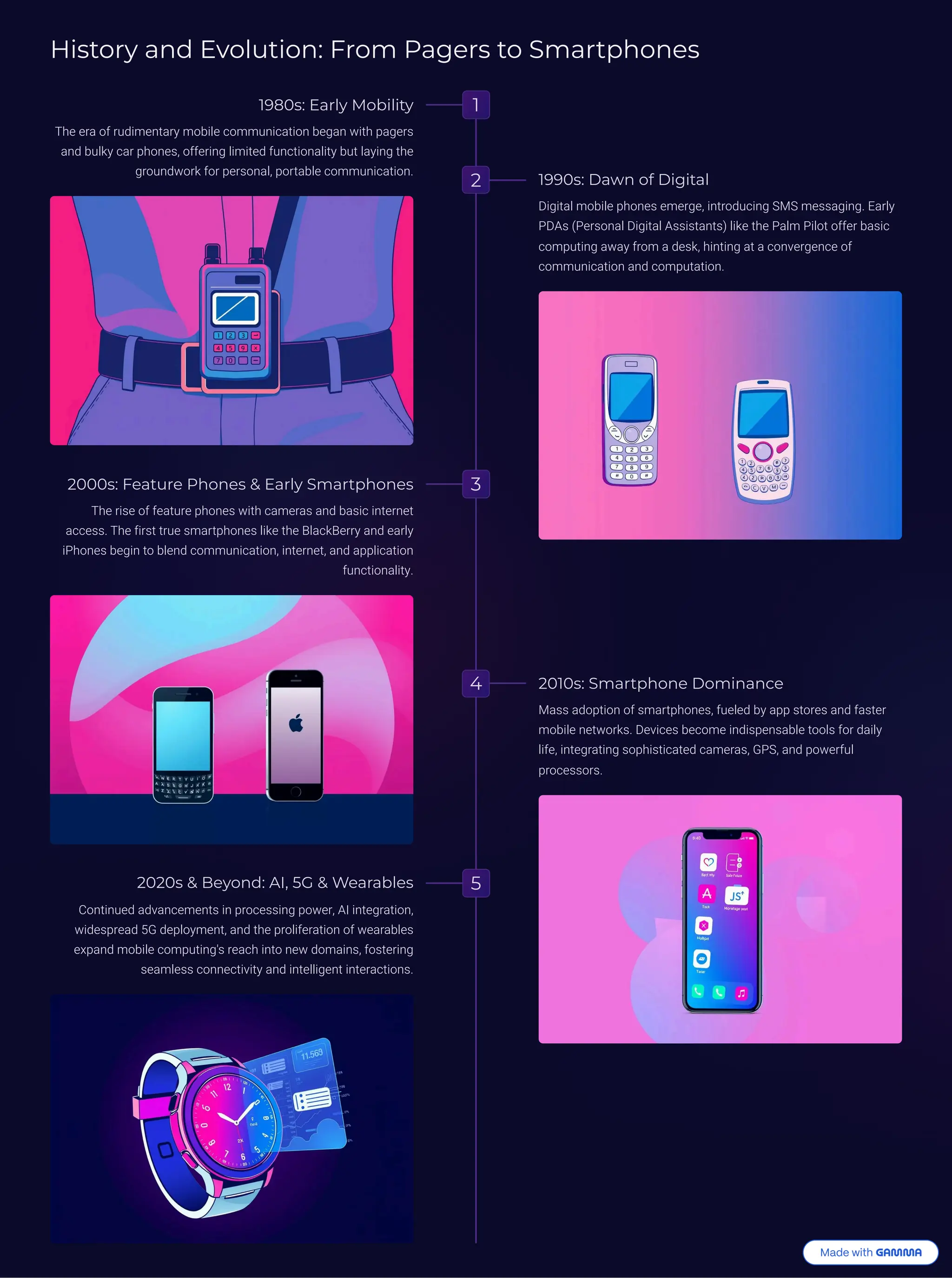
1980s: Early Mobility
The era of rudimentary mobile communication began with pagers
and bulky car phones, offering limited functionality but laying the
groundwork for personal, portable communication.
2 1990s: Dawn of Digital
Digital mobile phones emerge, introducing SMS messaging. Early
PDAs (Personal Digital Assistants) like the Palm Pilot offer basic
computing away from a desk, hinting at a convergence of
communication and computation.
3
2000s: Feature Phones & Early Smartphones
The rise of feature phones with cameras and basic internet
access. The first true smartphones like the BlackBerry and early
iPhones begin to blend communication, internet, and application
functionality.
4 2010s: Smartphone Dominance
Mass adoption of smartphones, fueled by app stores and faster
mobile networks. Devices become indispensable tools for daily
life, integrating sophisticated cameras, GPS, and powerful
processors.
5
2020s & Beyond: AI, 5G & Wearables
Continued advancements in processing power, AI integration,
widespread 5G deployment, and the proliferation of wearables
expand mobile computing's reach into new domains, fostering
seamless connectivity and intelligent interactions.
4.
Mobile Device Architecture:Hardware and Software
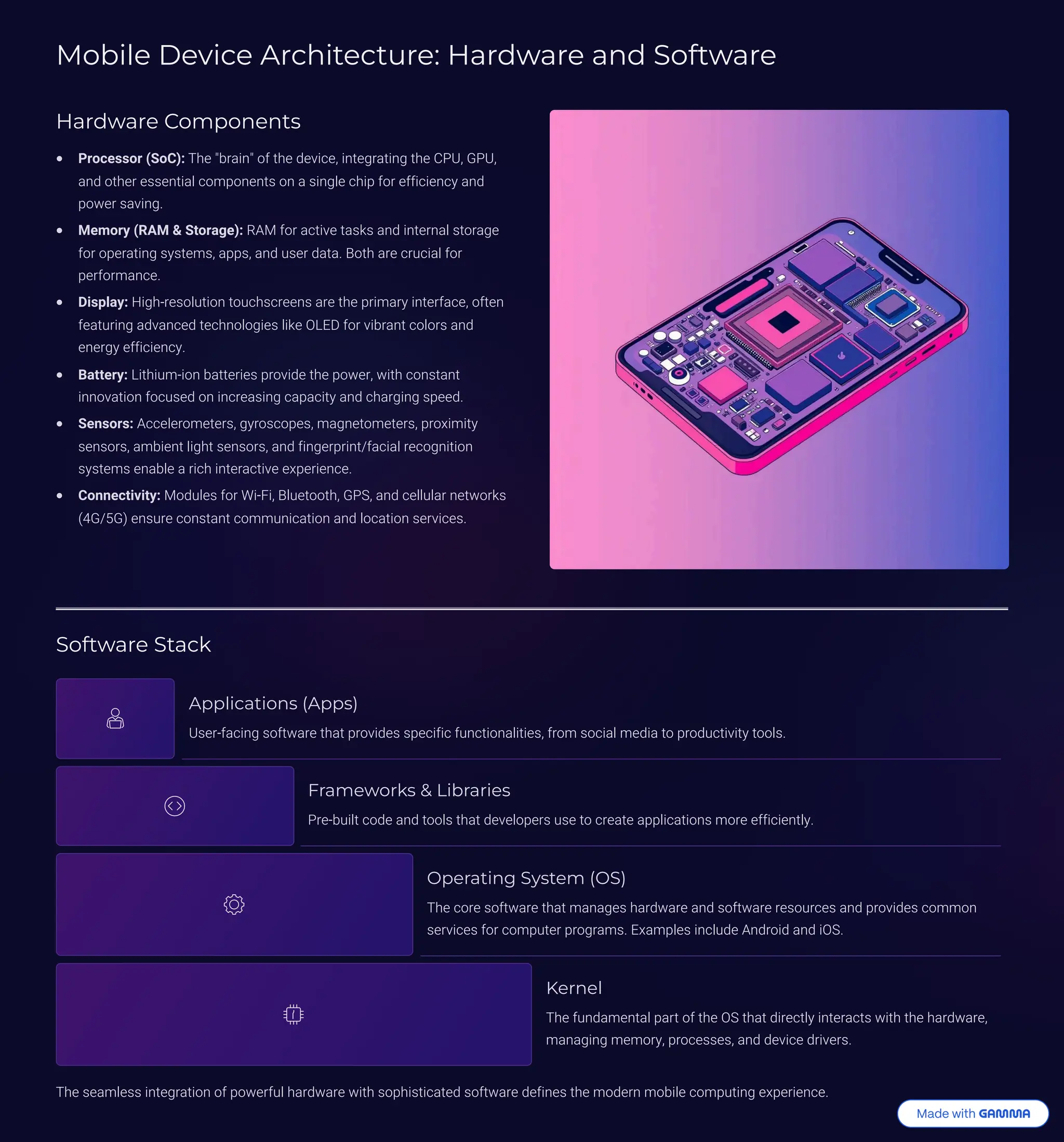
Hardware Components
Processor (SoC): The "brain" of the device, integrating the CPU, GPU,
and other essential components on a single chip for efficiency and
power saving.
Memory (RAM & Storage): RAM for active tasks and internal storage
for operating systems, apps, and user data. Both are crucial for
performance.
Display: High-resolution touchscreens are the primary interface, often
featuring advanced technologies like OLED for vibrant colors and
energy efficiency.
Battery: Lithium-ion batteries provide the power, with constant
innovation focused on increasing capacity and charging speed.
Sensors: Accelerometers, gyroscopes, magnetometers, proximity
sensors, ambient light sensors, and fingerprint/facial recognition
systems enable a rich interactive experience.
Connectivity: Modules for Wi-Fi, Bluetooth, GPS, and cellular networks
(4G/5G) ensure constant communication and location services.
Software Stack
Applications (Apps)
User-facing software that provides specific functionalities, from social media to productivity tools.
Frameworks & Libraries
Pre-built code and tools that developers use to create applications more efficiently.
Operating System (OS)
The core software that manages hardware and software resources and provides common
services for computer programs. Examples include Android and iOS.
Kernel
The fundamental part of the OS that directly interacts with the hardware,
managing memory, processes, and device drivers.
The seamless integration of powerful hardware with sophisticated software defines the modern mobile computing experience.
5.
Mobile Operating Systems:Android, iOS, and Beyond
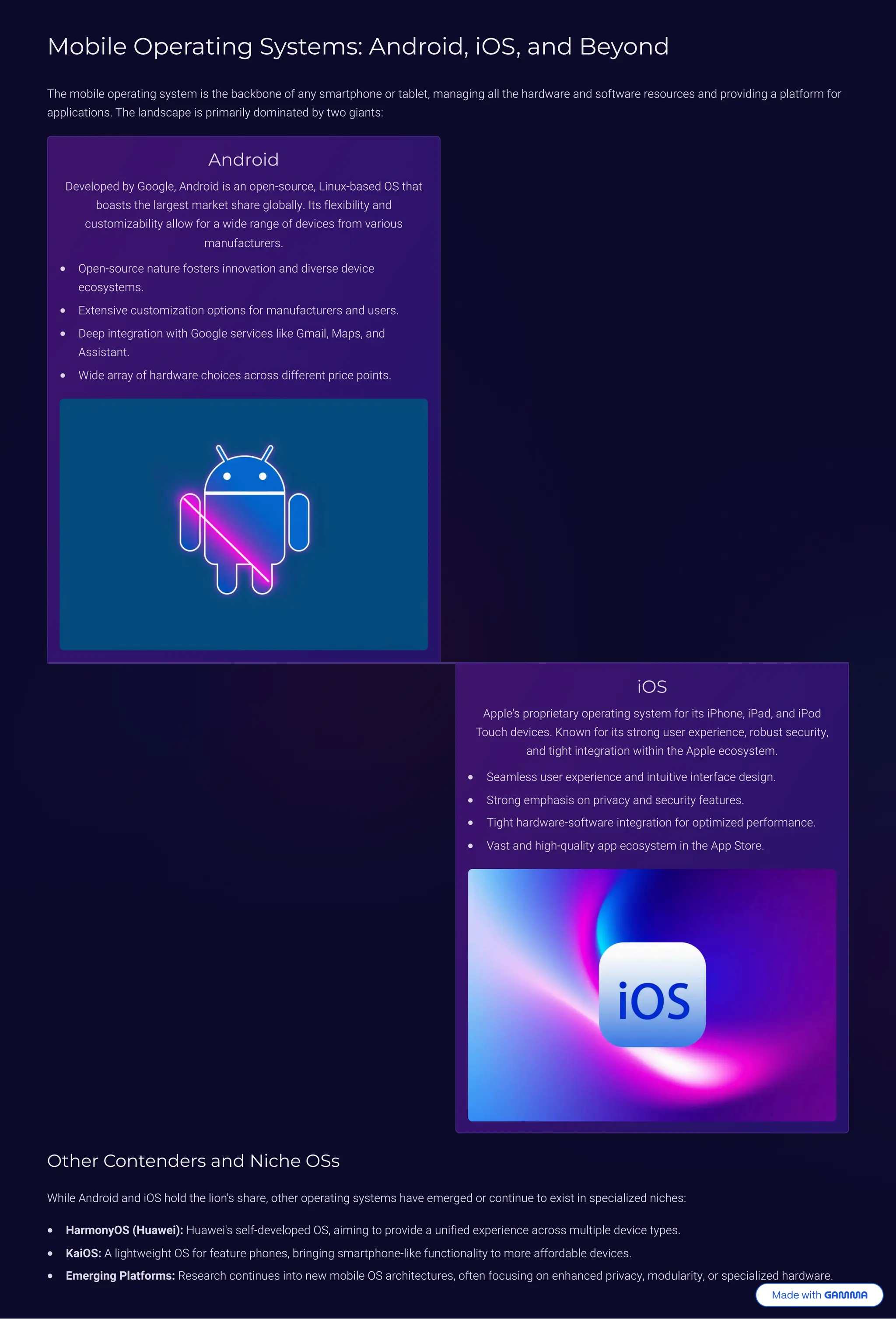
The mobile operating system is the backbone of any smartphone or tablet, managing all the hardware and software resources and providing a platform for
applications. The landscape is primarily dominated by two giants:
Android
Developed by Google, Android is an open-source, Linux-based OS that
boasts the largest market share globally. Its flexibility and
customizability allow for a wide range of devices from various
manufacturers.
Open-source nature fosters innovation and diverse device
ecosystems.
Extensive customization options for manufacturers and users.
Deep integration with Google services like Gmail, Maps, and
Assistant.
Wide array of hardware choices across different price points.
iOS
Apple's proprietary operating system for its iPhone, iPad, and iPod
Touch devices. Known for its strong user experience, robust security,
and tight integration within the Apple ecosystem.
Seamless user experience and intuitive interface design.
Strong emphasis on privacy and security features.
Tight hardware-software integration for optimized performance.
Vast and high-quality app ecosystem in the App Store.
Other Contenders and Niche OSs
While Android and iOS hold the lion's share, other operating systems have emerged or continue to exist in specialized niches:
HarmonyOS (Huawei): Huawei's self-developed OS, aiming to provide a unified experience across multiple device types.
KaiOS: A lightweight OS for feature phones, bringing smartphone-like functionality to more affordable devices.
Emerging Platforms: Research continues into new mobile OS architectures, often focusing on enhanced privacy, modularity, or specialized hardware.
6.
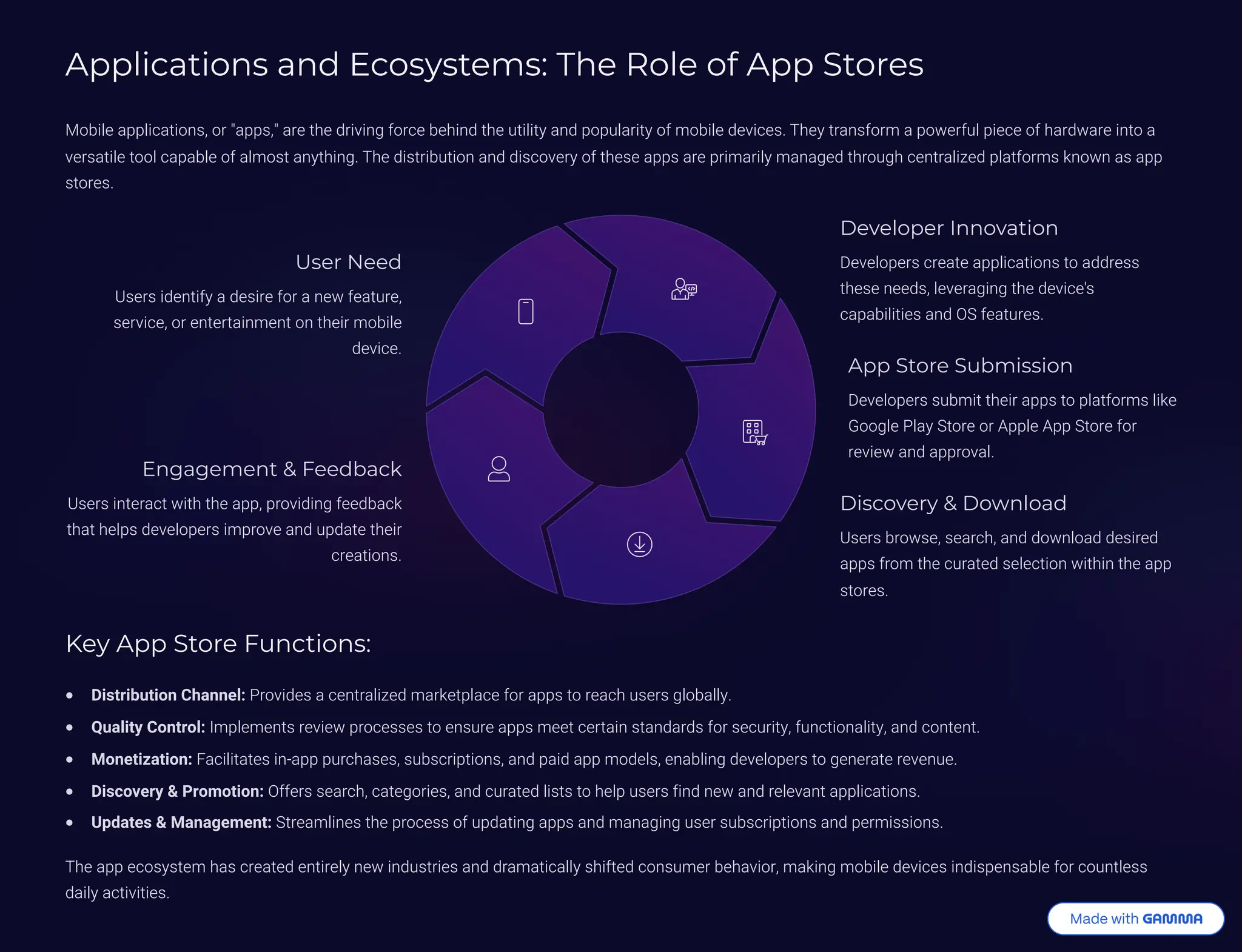
Applications and Ecosystems:The Role of App Stores
Mobile applications, or "apps," are the driving force behind the utility and popularity of mobile devices. They transform a powerful piece of hardware into a
versatile tool capable of almost anything. The distribution and discovery of these apps are primarily managed through centralized platforms known as app
stores.
Key App Store Functions:
Distribution Channel: Provides a centralized marketplace for apps to reach users globally.
Quality Control: Implements review processes to ensure apps meet certain standards for security, functionality, and content.
Monetization: Facilitates in-app purchases, subscriptions, and paid app models, enabling developers to generate revenue.
Discovery & Promotion: Offers search, categories, and curated lists to help users find new and relevant applications.
Updates & Management: Streamlines the process of updating apps and managing user subscriptions and permissions.
The app ecosystem has created entirely new industries and dramatically shifted consumer behavior, making mobile devices indispensable for countless
daily activities.
User Need
Users identify a desire for a new feature,
service, or entertainment on their mobile
device.
Developer Innovation
Developers create applications to address
these needs, leveraging the device's
capabilities and OS features.
App Store Submission
Developers submit their apps to platforms like
Google Play Store or Apple App Store for
review and approval.
Discovery & Download
Users browse, search, and download desired
apps from the curated selection within the app
stores.
Engagement & Feedback
Users interact with the app, providing feedback
that helps developers improve and update their
creations.
7.
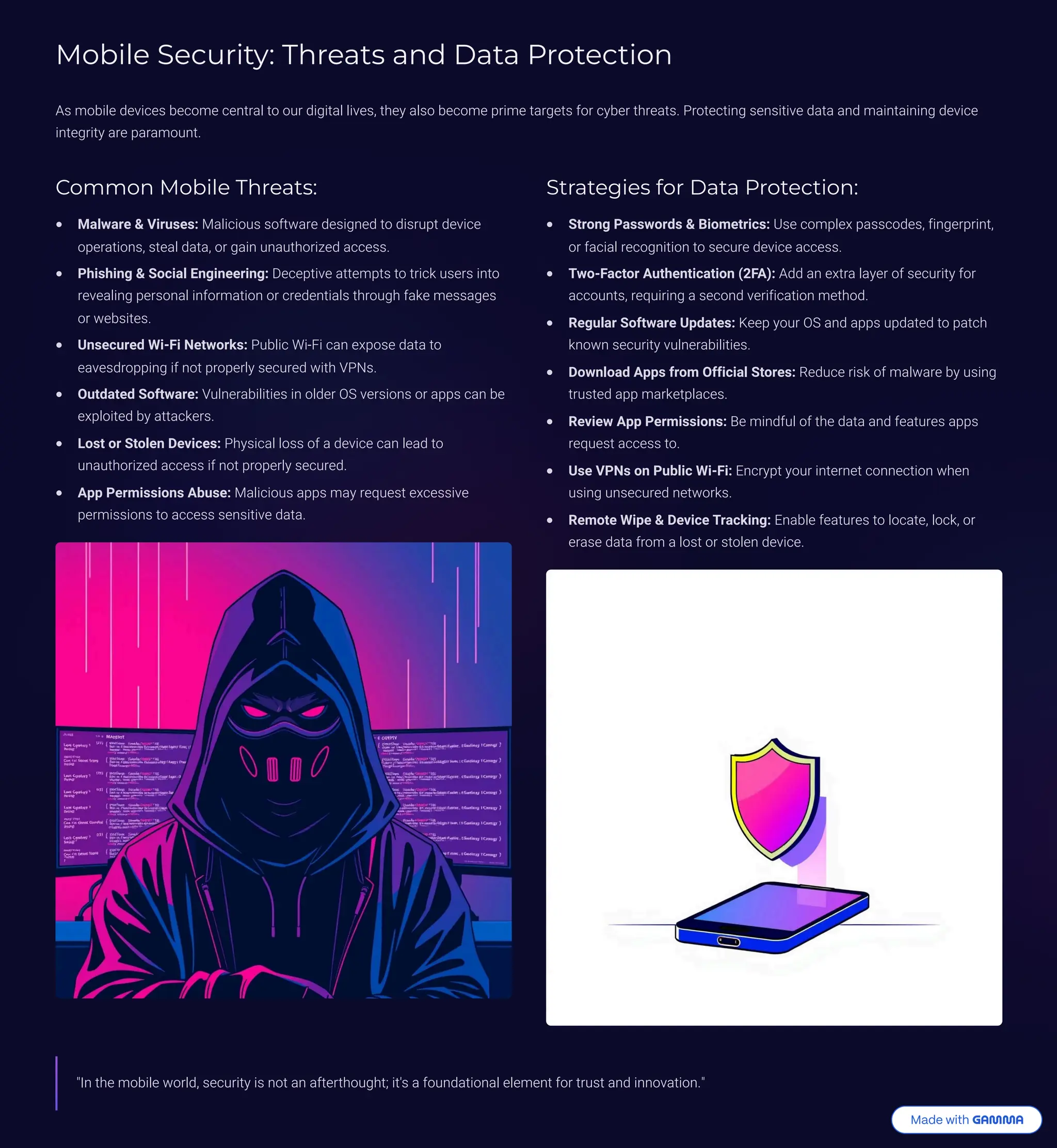
Mobile Security: Threatsand Data Protection
As mobile devices become central to our digital lives, they also become prime targets for cyber threats. Protecting sensitive data and maintaining device
integrity are paramount.
Common Mobile Threats:
Malware & Viruses: Malicious software designed to disrupt device
operations, steal data, or gain unauthorized access.
Phishing & Social Engineering: Deceptive attempts to trick users into
revealing personal information or credentials through fake messages
or websites.
Unsecured Wi-Fi Networks: Public Wi-Fi can expose data to
eavesdropping if not properly secured with VPNs.
Outdated Software: Vulnerabilities in older OS versions or apps can be
exploited by attackers.
Lost or Stolen Devices: Physical loss of a device can lead to
unauthorized access if not properly secured.
App Permissions Abuse: Malicious apps may request excessive
permissions to access sensitive data.
Strategies for Data Protection:
Strong Passwords & Biometrics: Use complex passcodes, fingerprint,
or facial recognition to secure device access.
Two-Factor Authentication (2FA): Add an extra layer of security for
accounts, requiring a second verification method.
Regular Software Updates: Keep your OS and apps updated to patch
known security vulnerabilities.
Download Apps from Official Stores: Reduce risk of malware by using
trusted app marketplaces.
Review App Permissions: Be mindful of the data and features apps
request access to.
Use VPNs on Public Wi-Fi: Encrypt your internet connection when
using unsecured networks.
Remote Wipe & Device Tracking: Enable features to locate, lock, or
erase data from a lost or stolen device.
"In the mobile world, security is not an afterthought; it's a foundational element for trust and innovation."
8.
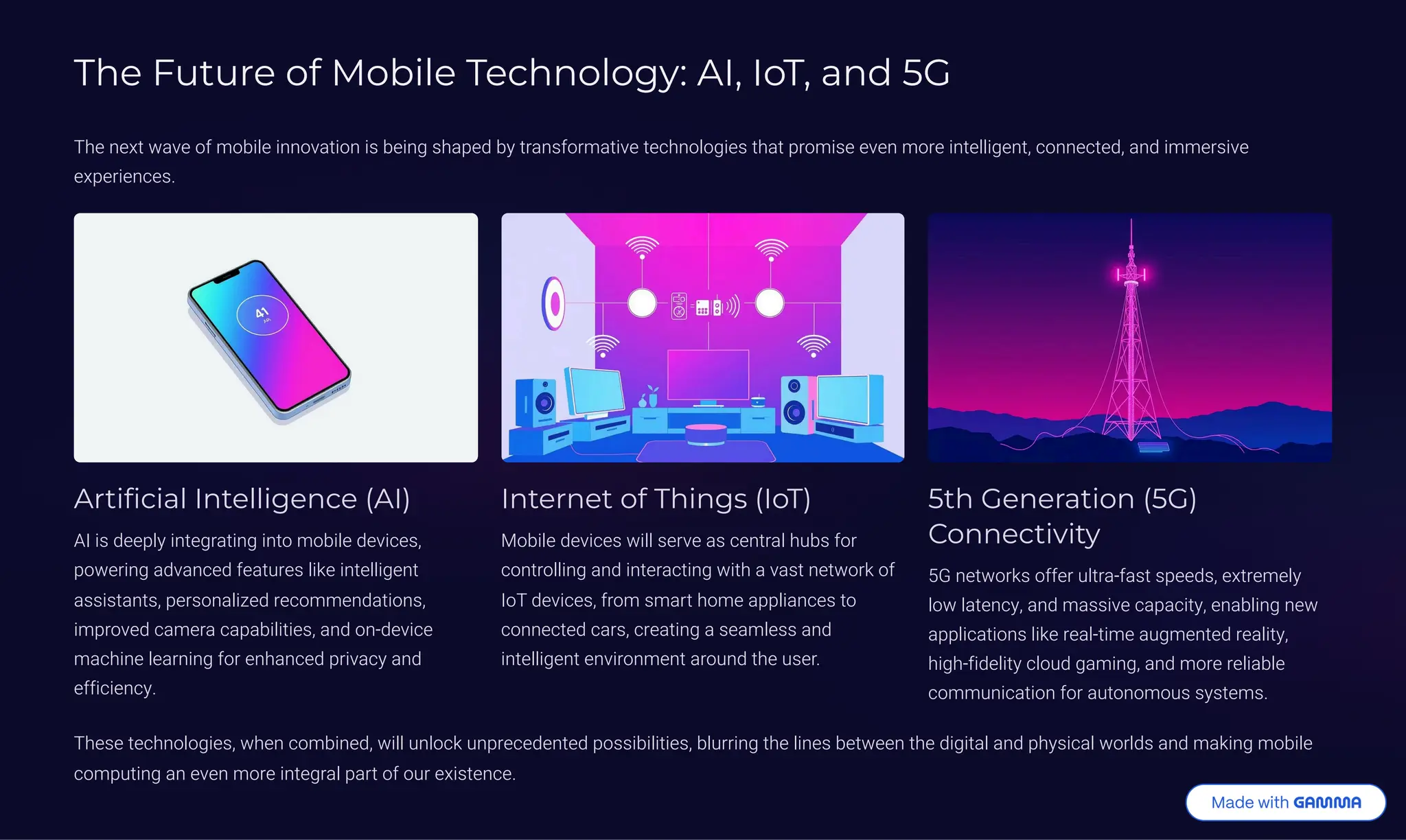
The Future ofMobile Technology: AI, IoT, and 5G
The next wave of mobile innovation is being shaped by transformative technologies that promise even more intelligent, connected, and immersive
experiences.
Artificial Intelligence (AI)
AI is deeply integrating into mobile devices,
powering advanced features like intelligent
assistants, personalized recommendations,
improved camera capabilities, and on-device
machine learning for enhanced privacy and
efficiency.
Internet of Things (IoT)
Mobile devices will serve as central hubs for
controlling and interacting with a vast network of
IoT devices, from smart home appliances to
connected cars, creating a seamless and
intelligent environment around the user.
5th Generation (5G)
Connectivity
5G networks offer ultra-fast speeds, extremely
low latency, and massive capacity, enabling new
applications like real-time augmented reality,
high-fidelity cloud gaming, and more reliable
communication for autonomous systems.
These technologies, when combined, will unlock unprecedented possibilities, blurring the lines between the digital and physical worlds and making mobile
computing an even more integral part of our existence.
9.
Societal Impact: TransformingWork, Communication, and
Entertainment
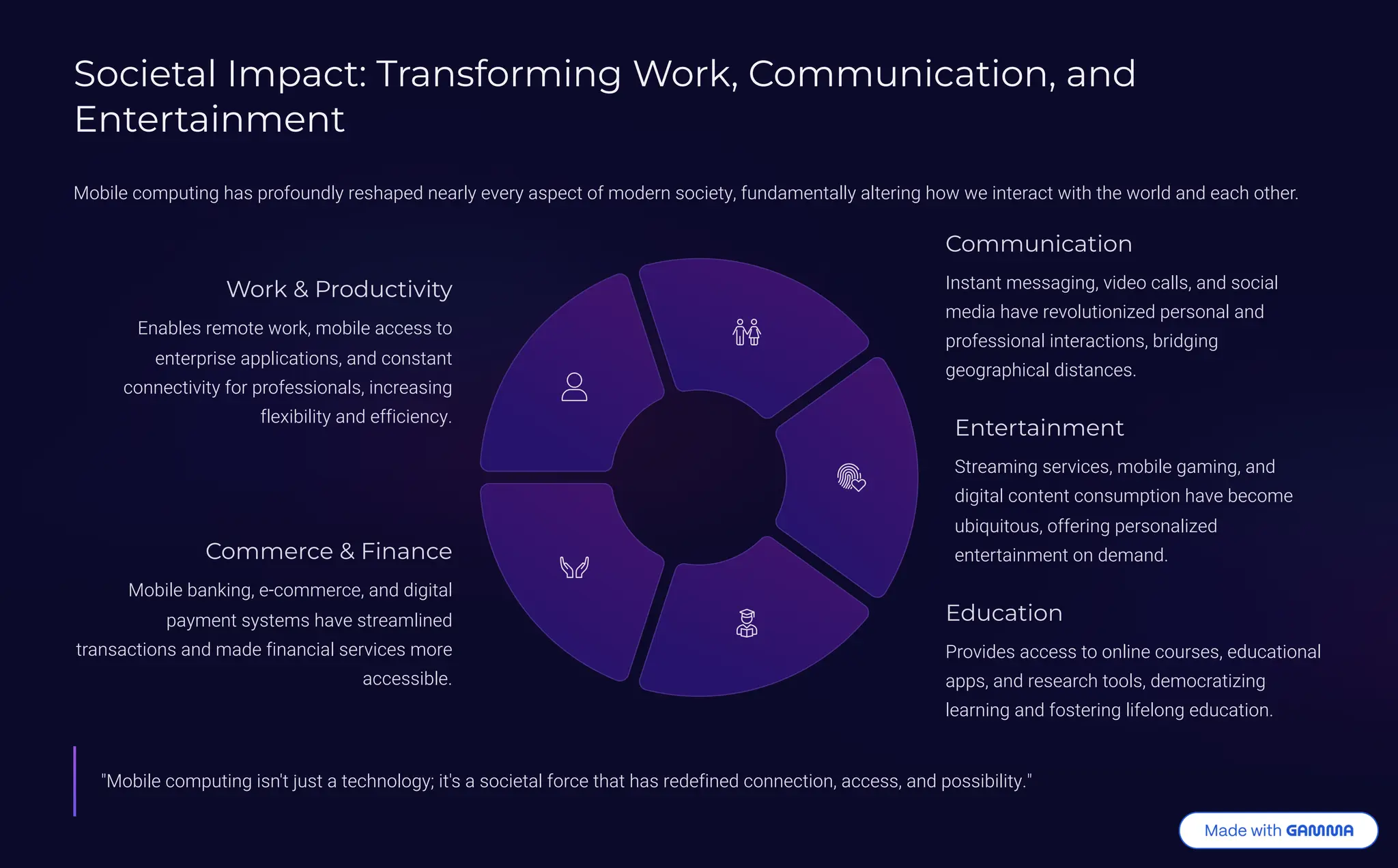
Mobile computing has profoundly reshaped nearly every aspect of modern society, fundamentally altering how we interact with the world and each other.
"Mobile computing isn't just a technology; it's a societal force that has redefined connection, access, and possibility."
Work & Productivity
Enables remote work, mobile access to
enterprise applications, and constant
connectivity for professionals, increasing
flexibility and efficiency.
Communication
Instant messaging, video calls, and social
media have revolutionized personal and
professional interactions, bridging
geographical distances.
Entertainment
Streaming services, mobile gaming, and
digital content consumption have become
ubiquitous, offering personalized
entertainment on demand.
Education
Provides access to online courses, educational
apps, and research tools, democratizing
learning and fostering lifelong education.
Commerce & Finance
Mobile banking, e-commerce, and digital
payment systems have streamlined
transactions and made financial services more
accessible.
10.
Conclusion: Mobile Computingas a Driving Force for Progress
Mobile computing has evolved from a niche technology to an indispensable pillar of modern life, relentlessly pushing the boundaries of what's possible. Its
journey from simple pagers to sophisticated smartphones exemplifies a relentless pursuit of connectivity, convenience, and capability.
As we look ahead, the convergence of Artificial Intelligence, the Internet of Things, and advanced 5G networks promises to amplify mobile computing's
impact even further. These synergistic technologies will create an even more seamless, intelligent, and interconnected world, where our devices anticipate
our needs and blend effortlessly into our environments.
The profound implications of this mobile revolution extend across every sector, from transforming global economies and revolutionizing healthcare to
democratizing access to information and reshaping social interactions. Mobile computing is not merely a tool; it is a catalyst for continuous innovation,
empowering individuals and driving humanity forward into an increasingly digital future.
The revolution continues, in the palm of our hands.